Kris Sims, British Columbia Director, Canadian Taxpayers Federation (CASTANET)
The Canadian Taxpayers Federation (CTF) has released its annual report crunching the numbers on new year’s tax changes for Canadians. Many Canadians will only see minor changes to their tax bill, but thanks to the Medical Services Premium (MSP) cut, British Columbians will be some of the largest beneficiaries come Jan. 1. The MSP is being sliced in half as of Jan. 1, 2018. This move saves an average two adult home $900 per year in mandatory healthcare taxes. The government has promised to eliminate the MSP completely within their four-year mandate. The CTF has long argued that this unfair, inefficient fee needed to be axed, and will maintain the pressure on government to get rid of it altogether, saving an additional $900 per year per average household.“The CTF campaigned hard for a cut to MSP, so we’re very pleased this unfair tax will be halved on Jan. 1,” said the CTF’s B.C. Director, Kris Sims. “With housing and fuel continuing to be less and less affordable in B.C., this significant tax relief is most welcome.”
There is some bad news coming later in the year, however, which will eat into the MSP tax savings. B.C.’s carbon tax will jump to $35 per ton in April, making it the highest carbon tax in Canada. That means the carbon tax price at the pumps will go up to about 8.5 cents per litre of gasoline and more than 10 cents for diesel. That means it will cost you more than $5 extra in carbon tax every time you fill up your car and nearly $10 tacked on if you drive an SUV. The carbon tax is also applied to natural gas and home heating oil. Starting this year, the B.C. carbon tax will no longer be labelled as “revenue neutral” and the money will pour into government coffers without earmarks or tracking as to where it’s spent. With more than 5.7 billion litres of gasoline sold in B.C. last year, that means the provincial government will rake in an average of $490 million in gasoline carbon tax, and when the diesel carbon tax is included, that jumps to more than $600 million in tax revenue taken from motorists in one year.“The carbon tax is going to cost us even more and now we have no idea where it’s going,” continued Sims. “If you have two vehicles in your family this means the carbon tax now costs you about $360 per year just to drive your kids to school and get yourself to work and the grocery store. This doesn’t include the costs of all those goods that need to be trucked in. We will pay for that too.”
Federally, Employment Insurance (EI) premiums will rise slightly, costing employees and employers an additional $9 and $13 per year, respectively. The indexation of the Canada Child Benefit (CCB) will also come into force on July 1, 2018, leading to a slight decrease in payments to eligible families on January 1st. “There are no dramatic income tax changes on the federal side,” said CTF Federal Director Aaron Wudrick. “Canadians can for the most part breathe easy, but they shouldn’t expect to have much more money in their pockets.”
Wudrick noted that while 2018 did not hold many large tax changes, Canadians can expect further changes in 2019. “The Trudeau government has delayed imposing its national carbon tax until 2019, and Canada Pension Plan premiums will begin to rise annually as well,” said Wudrick. “There is still considerable uncertainty on the business tax front, both with respect to the Trudeau government’s controversial small business tax proposals, and due to recent dramatic tax cuts south of the border which will impact Canada’s competitiveness.”
CTF calculations for the tax changes that will be occurring on Jan. 1 for 44 different income and family scenarios can be found here.
Carbon Tax
The federal government says it will implement a federal carbon tax in any province that does not have carbon pricing — that meets their
standard — by the end of 2018. If provinces don’t have a qualifying system in place, the federal government says it will impose a $10/tonne
carbon tax in that province. However, in some provinces the governments are imposing even higher carbon taxes.
• British Columbia: April 1st, 2018 the carbon tax rate will increase to $35/tonne from $30/tonne.
• Alberta: January 1
st, 2018 the carbon tax will increase to $30/tonne from $20/tonne.
• Saskatchewan: No plans for a carbon tax.
• Manitoba: Plans to introduce a $25/tonne tax sometime in 2018.
• Ontario: Has a cap-and-trade system and on January 1st, 2018 it joins the Quebec-California carbon market.
• Quebec: Has a cap-and-trade system.
• New Brunswick: Plans to shift 2.33 cents per litre of the provincial gas tax to be a carbon tax in 2018. With the funds directed to
programs to reduce carbon dioxide emissions.
• Nova Scotia: Plans to implement a cap-and-trade system on large emitters in 2018.
• Price Edward island: Plan expected in early 2018.
• Newfoundland and Labrador: Plan expected in the spring of 2018.
---------
Don Quixote Note: The carbon tax in B.C. is also subject to the 5% GST. This will add to the cost of filling up t he car or home heating (Natural gas). Also Gst will be applied to the carbon tax for cremations.
---------------
Showing posts with label GST. Show all posts
Showing posts with label GST. Show all posts
Saturday, December 30, 2017


Tuesday, December 12, 2017
Bill C-342 - Cost of carbon pricing deduction from GST
http://www.pbo-dpb.gc.ca/web/default/files/Documents/Reports/2017/Bill%20C-342/Bill%20C-342_EN.pdf
At above link is the full report from the office of the Parliamentary Budget officer (PBO)
 of the effect of elimination of GST from carbon tax as proposed in Bill c-342.
(On 20 March 2017, Mark Warawa, MP, introduced a private member’s bill, Bill C-342. The bill amends the Excise Tax Act to provide that any tax, duty or fee imposed in respect of carbon is excluded from the total purchase price for the purpose of calculating the goods and services tax. On 25 October 2017 the bill was defeated at second reading in the House of Commons. The analysis in this report may be useful in determining the impact of a Canada wide carbon pricing policy on revenue from the goods and services tax.)
------------
Don Quixote Note:
Looks like the end of our tax on tax battle. A special thanks
to MP's Mel Arnold and Mark Warawa for fighting this Quixotic battle in Parliament of Canada.
Also See:
Budget watchdog details millions in potential GST revenues on carbon pricing
http://www.cbc.ca/news/politics/pbo-carbon-gst-1.4444627?cmp=rss
At above link is the full report from the office of the Parliamentary Budget officer (PBO)

(On 20 March 2017, Mark Warawa, MP, introduced a private member’s bill, Bill C-342. The bill amends the Excise Tax Act to provide that any tax, duty or fee imposed in respect of carbon is excluded from the total purchase price for the purpose of calculating the goods and services tax. On 25 October 2017 the bill was defeated at second reading in the House of Commons. The analysis in this report may be useful in determining the impact of a Canada wide carbon pricing policy on revenue from the goods and services tax.)
------------
Don Quixote Note:
Looks like the end of our tax on tax battle. A special thanks
to MP's Mel Arnold and Mark Warawa for fighting this Quixotic battle in Parliament of Canada.
Also See:
Budget watchdog details millions in potential GST revenues on carbon pricing
http://www.cbc.ca/news/politics/pbo-carbon-gst-1.4444627?cmp=rss
Thursday, October 26, 2017
Bill C-342 defeated at 2nd Reading
SUMMARY
This enactment amends the Excise Tax Act to provide that any tax paid to a province in respect of carbon is excluded from the total purchase price for the purpose of calculating the goods and services tax.
Oct. 25, 2017 Failed 2nd reading of Bill C-342, An Act to amend the Excise Tax Act (carbon levy)
Vote Results by Member

_________________
Don Quixote Note: Mark Warawa (Langley—Aldergrove) brought this private members bill with Local MP Mel Arnold seconding it. This bill failed at second reading. A valiant effort at tax fairness from these 2 MP'S. ( Mel Arnold also was the sponsor of my original petition that was rejected in writing by the Government *see below for links to details and response)
This enactment amends the Excise Tax Act to provide that any tax paid to a province in respect of carbon is excluded from the total purchase price for the purpose of calculating the goods and services tax.
Oct. 25, 2017 Failed 2nd reading of Bill C-342, An Act to amend the Excise Tax Act (carbon levy)
Vote Results by Member

_________________
Don Quixote Note: Mark Warawa (Langley—Aldergrove) brought this private members bill with Local MP Mel Arnold seconding it. This bill failed at second reading. A valiant effort at tax fairness from these 2 MP'S. ( Mel Arnold also was the sponsor of my original petition that was rejected in writing by the Government *see below for links to details and response)
PETITION TO THE GOVERNMENT OF CANADA
Whereas:
- The Government of British Columbia instituted a carbon tax in 2008 and the federal government GST (currently at 5%) is still being charged on this carbon tax.
We, the undersigned, citizens of Canada, call upon the Government of Canada to eliminate the GST being charged on this or any other future carbon tax enacted by the provinces or territories.
RESPONSE TO PETITION
=============
Sunday, October 01, 2017
BC Conservative Party Launches Anti-Carbon Tax Petition
The British Columbia Conservative Party has launched a new website and petition dedicated to fighting the BC Liberal-imposed Carbon Tax. The new website is located at https://scrapthecarbontax-bcconservative.nationbuilder.com/petition
The BC Liberal Party first introduced the Carbon Tax in 2008, and planned to eventually raise it. Now the tax-hungry BC NDP, with the active encouragement of the BC Green party, has vowed to not only raise the tax, but go a step further and drop all pretense of revenue neutrality.
The BC Conservatives have steadfastly rejected the Carbon Tax as a punitive tax on the poor and middle class. Following a threat by the federal Liberal Party to impose a national carbon tax, other western conservative parties have followed suit in a strong rejection of the tax, including the Saskatchewan Party and the United Conservative Party of Alberta.
“Conservatives across the west are united in opposition to this regressive, punitive tax that will hurt the poor and middle class, and won’t achieve what it is supposed to achieve,” said Scott Anderson, Director of Communications for the BC Conservatives. “It will drive up the cost of everything from farming to transportation, and in the absence of any commercially viable alternative energy source, it can’t possibly achieve any significant reduction in GHG production. It’s nothing but a green-washed tax grab.”
The website and petition are the latest tools in the ongoing BC Conservative advance against the Carbon Tax. “We have no intention of giving up this fight,” said Anderson. “A BC Conservative government will stand shoulder to shoulder with other western governments in firm opposition to this disgraceful tax grab.”
Scott Anderson | Director of Communications
BC Conservative Party
---------------------
The BC Liberal Party first introduced the Carbon Tax in 2008, and planned to eventually raise it. Now the tax-hungry BC NDP, with the active encouragement of the BC Green party, has vowed to not only raise the tax, but go a step further and drop all pretense of revenue neutrality.
The BC Conservatives have steadfastly rejected the Carbon Tax as a punitive tax on the poor and middle class. Following a threat by the federal Liberal Party to impose a national carbon tax, other western conservative parties have followed suit in a strong rejection of the tax, including the Saskatchewan Party and the United Conservative Party of Alberta.
“Conservatives across the west are united in opposition to this regressive, punitive tax that will hurt the poor and middle class, and won’t achieve what it is supposed to achieve,” said Scott Anderson, Director of Communications for the BC Conservatives. “It will drive up the cost of everything from farming to transportation, and in the absence of any commercially viable alternative energy source, it can’t possibly achieve any significant reduction in GHG production. It’s nothing but a green-washed tax grab.”
The website and petition are the latest tools in the ongoing BC Conservative advance against the Carbon Tax. “We have no intention of giving up this fight,” said Anderson. “A BC Conservative government will stand shoulder to shoulder with other western governments in firm opposition to this disgraceful tax grab.”
Scott Anderson | Director of Communications
BC Conservative Party
---------------------
1/2 billion of GST on Carbon Tax from B.C. Shipped off to Ottawa
Thursday, August 24, 2017
. 1/2 billion of GST on Carbon Tax from B.C. Shipped off to Ottawa
From the tables below you can see that the GST on Carbon Tax in the 2017 fiscal year was $61.0 million on Carbon Tax Revenue of $1,220 million. (I billion, 220 million)
From July 1, 2008 when Carbon Tax was introduced the total Carbon Tax Revenue to end of 2017 Fiscal was $9,714,000,000 (9.714 Billion) and the GST extracted (Tax on a Tax) was $485,750,000. (almost $486 million)
By the end of this fiscal year 2017 the GST shipped off to Ottawa has approached $1/2 billion.
https://www.fraserinstitute.org/sites/default/files/examining-the-revenue-neutrality-of-bcs-carbon-tax.pdf

From July 1, 2008 when Carbon Tax was introduced the total Carbon Tax Revenue to end of 2017 Fiscal was $9,714,000,000 (9.714 Billion) and the GST extracted (Tax on a Tax) was $485,750,000. (almost $486 million)
By the end of this fiscal year 2017 the GST shipped off to Ottawa has approached $1/2 billion.
https://www.fraserinstitute.org/sites/default/files/examining-the-revenue-neutrality-of-bcs-carbon-tax.pdf
 |
 |
| Updated to actual to end of 2017 fiscal (March 30th P.112 |

Friday, July 21, 2017
Tax on a tax remains
By Kate Bouey - CASTANET Jul 21, 2017 / 5:00 am
A local politician's effort to end a federal tax on B.C.'s carbon tax has come to naught. Vernon city councillor Bob Spiers launched a parliamentary e-petition, garnering 1,596 signatures from across the country between January and May, in a bid to get the matter before the House of Commons. And get there it did.
 In May, North Okanagan-Shuswap MP Mel Arnold presented the e-petition to the Commons, forcing the government to respond. “Pricing carbon pollution is a central component of the pan-Canadian framework on Clean Growth and Climate Change that was announced by Canada’s first ministers in December 2016,” said a statement issued by Liberal MP Ginette Petitpas Taylor on behalf of the finance minister this week. “The pan-Canadian approach to pricing carbon pollution will expand the application of carbon pricing, already in place in Canada’s four largest provinces, to the rest of Canada by 2018.”
In other words, once the other provinces impose the carbon tax on sales of gasoline and home heating fuel, that will be taxed by Ottawa, too. In B.C. and Alberta alone, the federal government stands to raise as much as $280 million in GST revenue off provincial carbon taxes in the next two years, despite claims carbon taxes would be revenue neutral for Ottawa, according to a report. “The previous government didn't address it, and now all the provinces could be saddled with this carbon tax and the GST,” said Spiers.
Spiers said his last hope is in a private member's bill, which is expected to get second g when the Commons returns after the summer break, although he is doubtful that will pass.
-----------
Feds Won’t Drop GST On Carbon Tax
Vernon, BC, Canada / 1075 KISS FM Pete McIntyre July 21, 2017 06:52 am
The federal government has rejected Vernon city councillor Bob Spiers’ attempt to drop the GST from the carbon tax.
 His online petition received one thousand 596 signatures. The government says on its website that pricing carbon pollution is a central component of the pan-Canadian framework on Clean growth and Climate Change. It goes on to suggest that other provinces will also see the GST applied once they implement a carbon tax.“Very disappointed but it wasn’t unexpected. They’ve been doing it for eight years.” Spiers says he hoped the government would see the reasoning behind it, especially since the Prime Minister has said all the revenue from the carbon tax would remain in the province in which it’s collected. “Again, fighting this one since 2008 I guess. But that is the response and that ends that portion of the thing.” Spiers notes a private member’s on the same proposal goes up for 2nd reading in the Commons in the fall.He doesn’t expect that to go anywhere.
Spiers says he might start a campaign to dump the carbon tax on home heating fuel.“If it was removed from there, therefore the GST would also be removed on the federal level because there wouldn’t be any carbon tax on your bill when it came in from Fortis.” He admits that’s probably a pipe dream. Spiers says he thinks what’s really stupid is there’s a carbon tax on cremation. ” Talk about death and taxes.” North Okanagan-Shuswap MP Mel Arnold tabled the petition in the House of Commons on behalf of Spiers.
++++++++++++++++++++++++
https://petitions.ourcommons.ca/en/Petition/Details?Petition=e-713
http://www.ourcommons.ca/Content/ePetitions/Responses/421/e-713/421-01332_FIN_E.pdf
http://www.parl.ca/DocumentViewer/en/42-1/bill/C-342/first-reading
A local politician's effort to end a federal tax on B.C.'s carbon tax has come to naught. Vernon city councillor Bob Spiers launched a parliamentary e-petition, garnering 1,596 signatures from across the country between January and May, in a bid to get the matter before the House of Commons. And get there it did.
In other words, once the other provinces impose the carbon tax on sales of gasoline and home heating fuel, that will be taxed by Ottawa, too. In B.C. and Alberta alone, the federal government stands to raise as much as $280 million in GST revenue off provincial carbon taxes in the next two years, despite claims carbon taxes would be revenue neutral for Ottawa, according to a report. “The previous government didn't address it, and now all the provinces could be saddled with this carbon tax and the GST,” said Spiers.
Spiers said his last hope is in a private member's bill, which is expected to get second g when the Commons returns after the summer break, although he is doubtful that will pass.
-----------
Feds Won’t Drop GST On Carbon Tax
Vernon, BC, Canada / 1075 KISS FM Pete McIntyre July 21, 2017 06:52 am
The federal government has rejected Vernon city councillor Bob Spiers’ attempt to drop the GST from the carbon tax.
 |
| "Whatever model a province chooses, Trudeau said, it will be revenue neutral for the federal government, with any revenues generated under the system staying in the province or territory where they are generated." |
 His online petition received one thousand 596 signatures. The government says on its website that pricing carbon pollution is a central component of the pan-Canadian framework on Clean growth and Climate Change. It goes on to suggest that other provinces will also see the GST applied once they implement a carbon tax.“Very disappointed but it wasn’t unexpected. They’ve been doing it for eight years.” Spiers says he hoped the government would see the reasoning behind it, especially since the Prime Minister has said all the revenue from the carbon tax would remain in the province in which it’s collected. “Again, fighting this one since 2008 I guess. But that is the response and that ends that portion of the thing.” Spiers notes a private member’s on the same proposal goes up for 2nd reading in the Commons in the fall.He doesn’t expect that to go anywhere.
Spiers says he might start a campaign to dump the carbon tax on home heating fuel.“If it was removed from there, therefore the GST would also be removed on the federal level because there wouldn’t be any carbon tax on your bill when it came in from Fortis.” He admits that’s probably a pipe dream. Spiers says he thinks what’s really stupid is there’s a carbon tax on cremation. ” Talk about death and taxes.” North Okanagan-Shuswap MP Mel Arnold tabled the petition in the House of Commons on behalf of Spiers.
++++++++++++++++++++++++
https://petitions.ourcommons.ca/en/Petition/Details?Petition=e-713
http://www.ourcommons.ca/Content/ePetitions/Responses/421/e-713/421-01332_FIN_E.pdf
http://www.parl.ca/DocumentViewer/en/42-1/bill/C-342/first-reading
Wednesday, July 19, 2017
Gst will continue on carbon Tax !!! . 1/2 billion on GST on carbon tax in B.C. since 2008
https://petitions.ourcommons.ca/en/Petition/Details?Petition=e-713
PETITION TO THE GOVERNMENT OF CANADA
Whereas:
The Government of British Columbia instituted a carbon tax in 2008 and the federal government GST (currently at 5%) is still being charged on this carbon tax.
We, the undersigned, citizens of Canada, call upon the Government of Canada to eliminate the GST being charged on this or any other future carbon tax enacted by the provinces or territories.
GOVERNMENT'S Tabled Response:
http://www.ourcommons.ca/Content/ePetitions/Responses/421/e-713/421-01332_FIN_E.pdf
PETITION NO.: 421-01332 BY: MR. ARNOLD (NORTH OKANAGAN-SHUSWAP)DATE: MAY 15, 2017
PRINT NAME OF SIGNATORY: THE HONOURABLE GINETTE PETITPAS TAYLOR
Response by the Minister of Finance SIGNATURE
Minister or Parliamentary Secretary
SUBJECT
Tax system
ORIGINAL TEXT
REPLY
The Goods and Services Tax (GST) is a broad-based tax on consumption in Canada. Applying the GST to a broad base of goods and services keeps the tax more efficient, simpler and lower.
The GST is calculated on the final amount charged for a good or service. The general rule that was adopted at the inception of the GST is that this final amount includes other taxes, levies and charges that apply to the good or service and that may be embedded in the final price. This final amount includes customs duties, federal and provincial fuel and tobacco product taxes, as well as carbon taxes and other environmental levies. This final amount does not include general provincial sales taxes. This longstanding approach to calculating the GST helps to maintain the broad-based nature of the tax and ensures that the tax is applied evenly across goods and services consumed in Canada. It also simplifies the vendor’s calculation of the amount of tax payable, since the vendor is not required to back out other taxes, levies and charges at the point of sale in order to determine the amount of GST payable. This approach is likewise easy for consumers to understand and for the Canada Revenue Agency to administer.
2/2
Pricing carbon pollution is a central component of the Pan-Canadian Framework on Clean Growth and Climate Change that was announced by Canada’s First Ministers in December 2016. The pan-Canadian approach to pricing carbon pollution will expand the application of carbon pricing, already in place in Canada’s four largest provinces, to the rest of Canada by 2018. Recognizing that each province and territory has unique circumstances, the pan-Canadian approach allows provinces and territories flexibility to choose between a direct price on carbon pollution and a cap-and-trade
system. As part of the Pan-Canadian Framework, the Government of Canada will introduce a backstop carbon
pollution pricing system that will apply in provinces and territories that do not have a carbon pricing system in place that meets the federal carbon pricing benchmark by 2018. The details of the proposed federal carbon pricing backstop are outlined in a technical paper which can be accessed at https://www.canada.ca/en/services/environment/weather/climatechange/technical-paper-federal-carbonpricing-backstop.html.
Comments on the technical paper are welcome up to June 30, 2017. As committed in the October 3, 2016 document Pan-Canadian Approach to Pricing Carbon Pollution, the federal system will
return direct revenues from the carbon price to the jurisdiction of origin.
PETITION TO THE GOVERNMENT OF CANADA
Whereas:
The Government of British Columbia instituted a carbon tax in 2008 and the federal government GST (currently at 5%) is still being charged on this carbon tax.
We, the undersigned, citizens of Canada, call upon the Government of Canada to eliminate the GST being charged on this or any other future carbon tax enacted by the provinces or territories.
GOVERNMENT'S Tabled Response:
http://www.ourcommons.ca/Content/ePetitions/Responses/421/e-713/421-01332_FIN_E.pdf
PETITION NO.: 421-01332 BY: MR. ARNOLD (NORTH OKANAGAN-SHUSWAP)DATE: MAY 15, 2017
PRINT NAME OF SIGNATORY: THE HONOURABLE GINETTE PETITPAS TAYLOR
Response by the Minister of Finance SIGNATURE
Minister or Parliamentary Secretary
SUBJECT
Tax system
ORIGINAL TEXT
REPLY
The Goods and Services Tax (GST) is a broad-based tax on consumption in Canada. Applying the GST to a broad base of goods and services keeps the tax more efficient, simpler and lower.
The GST is calculated on the final amount charged for a good or service. The general rule that was adopted at the inception of the GST is that this final amount includes other taxes, levies and charges that apply to the good or service and that may be embedded in the final price. This final amount includes customs duties, federal and provincial fuel and tobacco product taxes, as well as carbon taxes and other environmental levies. This final amount does not include general provincial sales taxes. This longstanding approach to calculating the GST helps to maintain the broad-based nature of the tax and ensures that the tax is applied evenly across goods and services consumed in Canada. It also simplifies the vendor’s calculation of the amount of tax payable, since the vendor is not required to back out other taxes, levies and charges at the point of sale in order to determine the amount of GST payable. This approach is likewise easy for consumers to understand and for the Canada Revenue Agency to administer.
2/2
Pricing carbon pollution is a central component of the Pan-Canadian Framework on Clean Growth and Climate Change that was announced by Canada’s First Ministers in December 2016. The pan-Canadian approach to pricing carbon pollution will expand the application of carbon pricing, already in place in Canada’s four largest provinces, to the rest of Canada by 2018. Recognizing that each province and territory has unique circumstances, the pan-Canadian approach allows provinces and territories flexibility to choose between a direct price on carbon pollution and a cap-and-trade
system. As part of the Pan-Canadian Framework, the Government of Canada will introduce a backstop carbon
pollution pricing system that will apply in provinces and territories that do not have a carbon pricing system in place that meets the federal carbon pricing benchmark by 2018. The details of the proposed federal carbon pricing backstop are outlined in a technical paper which can be accessed at https://www.canada.ca/en/services/environment/weather/climatechange/technical-paper-federal-carbonpricing-backstop.html.
Comments on the technical paper are welcome up to June 30, 2017. As committed in the October 3, 2016 document Pan-Canadian Approach to Pricing Carbon Pollution, the federal system will
return direct revenues from the carbon price to the jurisdiction of origin.
Friday, June 09, 2017
Debate in House of Commons on BILL C342 - No more GST on Carbon Tax
At this link you can see the Debate on Bill C342 on June 8 in the House of Commons. Fast forward to 17:31 on link to get full debate on Bill C342
http://parlvu.parl.gc.ca/XRender/en/PowerBrowser/PowerBrowserV2/20170608/-1/27536?useragent=Mozilla/5.0%20(Macintosh;%20Intel%20Mac%20OS%20X%2010_11_6)%20AppleWebKit/537.36%20(KHTML,%20like%20Gecko)%20Chrome/58.0.3029.110%20Safari/537.36
At about 18:00 is the start of the Governments Response (effectively saying the Government will not supporr this bill being sent to Committee)
http://parlvu.parl.gc.ca/XRender/en/PowerBrowser/PowerBrowserV2/20170608/-1/27536?useragent=Mozilla/5.0%20(Macintosh;%20Intel%20Mac%20OS%20X%2010_11_6)%20AppleWebKit/537.36%20(KHTML,%20like%20Gecko)%20Chrome/58.0.3029.110%20Safari/537.36
At about 18:00 is the start of the Governments Response (effectively saying the Government will not supporr this bill being sent to Committee)
Mr. Marc Miller (Parliamentary Secretary to the Minister of Infrastructure and Communities, Lib.): (18:00)
The bill before us today proposes a tax treatment that is inefficient and fails to support our environmental objectives and priorities. We are proposing to move forward in a clear and cohesive way in co-operation with provinces and municipalities while making sure the middle class and those trying hard to join it are properly protected through a fair and equitable tax system.
For these reasons, the government opposes this legislation.
Thursday, June 08, 2017
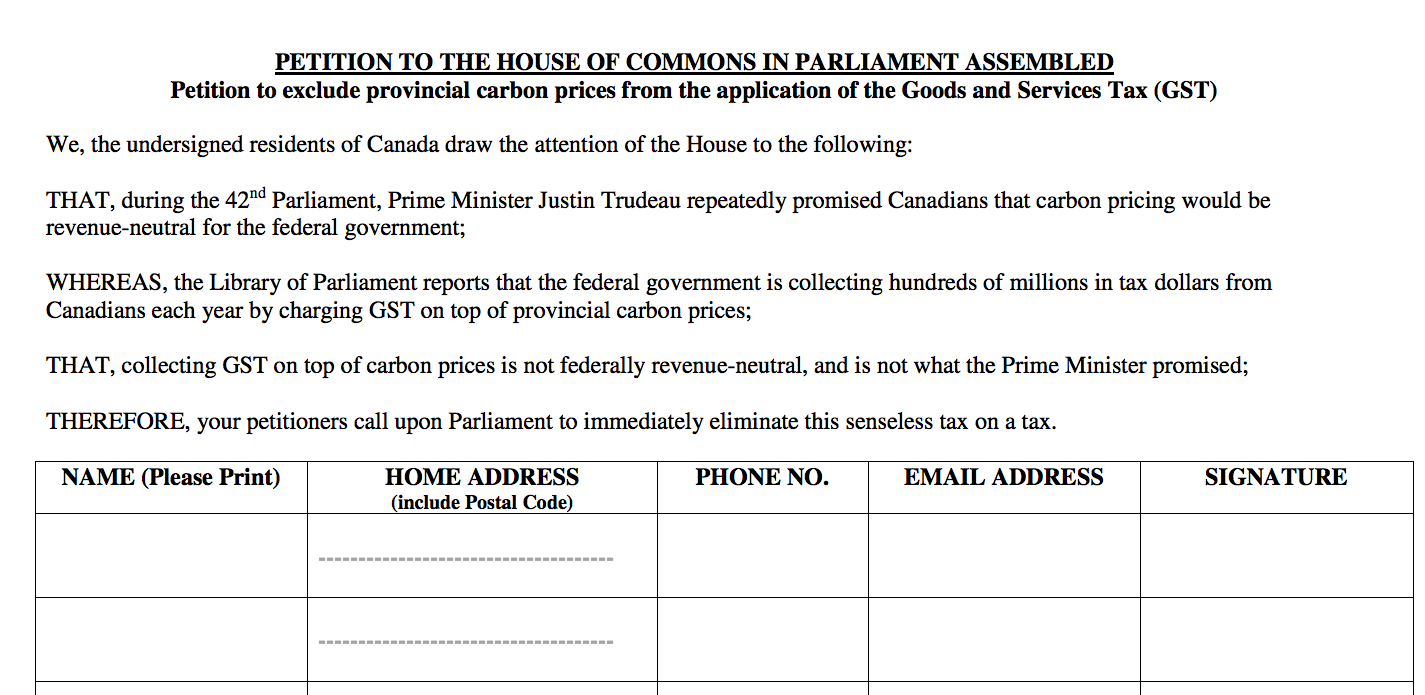
No GST on Carbon Tax Bill up for debate on June 8.


Tuesday, May 30, 2017
Question in Parliament re GST on Carbon Tax
Question No. 982 Questions on the Order Paper Routine Proceedings May 29th, 2017 / 3:20 p.m.
Conservative Mark Warawa Langley—Aldergrove, BC
With regard to the statement by the Minister of Environment and Climate Change in the House of Commons on April 10, 2017, that “Every dollar that comes from putting a price on carbon pollution to the federal government goes directly back to the provinces”: (a) does the government consider this statement to be accurate; (b) if the answer in (a) is affirmative, then how is the government disposing of the extra Goods and Services Tax collected as a result of collecting GST on the price of carbon; (c) when did the program to send the extra revenue collected from the GST back to the provinces begin; and (d) how much has been paid out to the provinces, broken down by province, as a result of such a program?
******************
ANSWER (??)
Question No. 982 Questions on the Order Paper Routine Proceedings 3:20 p.m.
Moncton—Riverview—Dieppe New Brunswick Liberal Ginette Petitpas Taylor Parliamentary Secretary to the Minister of Finance
Mr. Speaker, pricing carbon pollution is a central component of the pan-Canadian framework on clean growth and climate change that was announced by Canada’s first ministers in December 2016. The pan-Canadian approach to pricing carbon pollution will expand the application of carbon pricing, which is already in place in Canada’s four largest provinces, to the rest of Canada by 2018. Recognizing that each province and territory has unique circumstances, the pan-Canadian approach allows provinces and territories flexibility to choose between a direct price on carbon pollution and a cap and trade system. As part of the pan Canadian framework, the Government of Canada will introduce a backstop carbon pollution pricing system that will apply in provinces and territories that do not have a carbon pricing system in place that meets the federal carbon pricing benchmark by 2018.
The pan-Canadian framework includes the commitment that revenues from pricing carbon pollution will remain with the province or territory of origin, each of which will decide how best to use the revenue. These revenues do not include those in respect of the GST charged on products or services that may have embedded carbon pricing costs in them. Revenues generated by the federal backstop will be returned to the jurisdiction in which the backstop revenues originated.
The Government is making investments to address climate change and support a healthy environment, through the Pan-Canadian Framework and other measures. Budget 2016 provided almost $2.9 billion over five years to address climate change and air pollution. This included $2 billion to establish the Low Carbon Economy Fund to support provincial and territorial actions that materially reduce greenhouse gas emissions. Budget 2017 proposes a number of new and renewed actions to reduce emissions, help Canada adapt and build resilience to climate change and support clean technologies. To further advance Canada’s efforts to build a clean economy, Budget 2017 lays out the Government’s plan to invest $21.9 billion in green infrastructure. This includes programs and projects that will meet the goals outlined in the Pan-Canadian Framework.
-------------
Don Quixote Note: From this evasive answer to the question of whether Carbon Tax would be exempt from GST (Tax on a TAX) I can only predict that it for-shadows a negative response to the E-713 Petition that must be responded to by the Government within 45 days of Mat 4, The Private Members Bill C-342 that will be debated on June 8 that would stop this Tax on a Tax also appears to be rejected by the Liberal Majority.
Conservative Mark Warawa Langley—Aldergrove, BC
With regard to the statement by the Minister of Environment and Climate Change in the House of Commons on April 10, 2017, that “Every dollar that comes from putting a price on carbon pollution to the federal government goes directly back to the provinces”: (a) does the government consider this statement to be accurate; (b) if the answer in (a) is affirmative, then how is the government disposing of the extra Goods and Services Tax collected as a result of collecting GST on the price of carbon; (c) when did the program to send the extra revenue collected from the GST back to the provinces begin; and (d) how much has been paid out to the provinces, broken down by province, as a result of such a program?
******************
ANSWER (??)
Question No. 982 Questions on the Order Paper Routine Proceedings 3:20 p.m.
Moncton—Riverview—Dieppe New Brunswick Liberal Ginette Petitpas Taylor Parliamentary Secretary to the Minister of Finance
Mr. Speaker, pricing carbon pollution is a central component of the pan-Canadian framework on clean growth and climate change that was announced by Canada’s first ministers in December 2016. The pan-Canadian approach to pricing carbon pollution will expand the application of carbon pricing, which is already in place in Canada’s four largest provinces, to the rest of Canada by 2018. Recognizing that each province and territory has unique circumstances, the pan-Canadian approach allows provinces and territories flexibility to choose between a direct price on carbon pollution and a cap and trade system. As part of the pan Canadian framework, the Government of Canada will introduce a backstop carbon pollution pricing system that will apply in provinces and territories that do not have a carbon pricing system in place that meets the federal carbon pricing benchmark by 2018.
The pan-Canadian framework includes the commitment that revenues from pricing carbon pollution will remain with the province or territory of origin, each of which will decide how best to use the revenue. These revenues do not include those in respect of the GST charged on products or services that may have embedded carbon pricing costs in them. Revenues generated by the federal backstop will be returned to the jurisdiction in which the backstop revenues originated.
The Government is making investments to address climate change and support a healthy environment, through the Pan-Canadian Framework and other measures. Budget 2016 provided almost $2.9 billion over five years to address climate change and air pollution. This included $2 billion to establish the Low Carbon Economy Fund to support provincial and territorial actions that materially reduce greenhouse gas emissions. Budget 2017 proposes a number of new and renewed actions to reduce emissions, help Canada adapt and build resilience to climate change and support clean technologies. To further advance Canada’s efforts to build a clean economy, Budget 2017 lays out the Government’s plan to invest $21.9 billion in green infrastructure. This includes programs and projects that will meet the goals outlined in the Pan-Canadian Framework.
-------------
Don Quixote Note: From this evasive answer to the question of whether Carbon Tax would be exempt from GST (Tax on a TAX) I can only predict that it for-shadows a negative response to the E-713 Petition that must be responded to by the Government within 45 days of Mat 4, The Private Members Bill C-342 that will be debated on June 8 that would stop this Tax on a Tax also appears to be rejected by the Liberal Majority.
Tuesday, May 16, 2017
GST Revenue from Carbon Tax in B.C.
Mel Arnold Introduces GST Carbon Tax Petition
Vernon, BC, Canada / 1075 KISS FM Tom Mark May 16, 2017 10:39 am
 North Okanagan-Shuswap MP Mel Arnold has introduced a petition in the House of Commons calling for an end to the GST being applied to carbon taxes. The petition was started by Vernon City Councillor Bob Spiers. Arnold agrees with Spiers it’s a tax on a tax and isn’t fair to families. ” So far it’s been almost half a billion dollars from BC that has gone to Ottawa into general revenue. We don’t necessarily see it coming back to the provinces.” The government has 45 days to respond to the petition. Langley MP Mark Warawa has also introduced a bill calling for the tax-on-tax to end. Arnold says the government has to act ” Either the Prime Minister is going to have to change what he stated about the tax revenues from carbon taxes being revenue neutral in the provinces or they will have to make a change on the GST being charged.” Arnold says “Taxing a tax is not the solution nor is it fair to Canadians and I will continue to work with citizens and colleagues to oppose and end this scheme.”
*****************
Don Quixote Note:
From the tables below you can see that the GST on Carbon Tax in the 2016 fiscal year was $61.7 million on Carbon Tax Revenue of $1,234 million. (I billion, 234 million)
From July 1, 2008 when Carbon Tax was introduced the total Carbon Tax Revenue to end of 2016 Fiscal was $8,538,000,000 (8.538 Billion) and the GST extracted (Tax on a Tax) was $426,900,000. (almost $429 million)
By the end of this fiscal year 2017 the GST shipped off to Ottawa will approach $1/2 billion.
Vernon, BC, Canada / 1075 KISS FM Tom Mark May 16, 2017 10:39 am

*****************
Don Quixote Note:
From the tables below you can see that the GST on Carbon Tax in the 2016 fiscal year was $61.7 million on Carbon Tax Revenue of $1,234 million. (I billion, 234 million)
From July 1, 2008 when Carbon Tax was introduced the total Carbon Tax Revenue to end of 2016 Fiscal was $8,538,000,000 (8.538 Billion) and the GST extracted (Tax on a Tax) was $426,900,000. (almost $429 million)
By the end of this fiscal year 2017 the GST shipped off to Ottawa will approach $1/2 billion.
|
 |
Monday, May 15, 2017
Tax on Tax Petition tabled in House of Commons Today.

==========
Stop 'tax-on-tax scheme'
by Darren Handschuh - May 15, 2017 / 3:46 pm CASTANET
Mel Arnold has asked his colleagues to get rid of a tax on a tax. Last year, Vernon city Coun. Bob Spiers launched an e-petition asking the federal government to eliminate what was essentially a tax on the carbon tax. The feds are applying the GST to the carbon tax, but on Monday the Okanagan-Shuswap Conservative MP tabled the petition in the House of Commons to get rid of the double tax. The online e-petition garnered 1,596 signatures from across Canada between January and May. It will now be assessed by the federal government which has to issue a formal written response within 45 days. “Now that the federal government has mandated that all provinces and territories establish a carbon tax regime by 2018, all Canadians will soon be subjected to this tax-on-tax scheme,” said Arnold. “I commend councillor Spiers for stepping forward with this important proposal and I will continue to fight this unfair tax scheme.” Spiers said he appreciates Arnold taking the matter to the highest government in the land. The 2016 federal budget projected GST revenue to increase by 21 per cent over five years while Budget 2017’s projection shows the federal government expects to grow its GST revenues by 24 per cent by 2021.A large portion of this increase in federal revenue is expected to result from charging GST on new provincial and territorial carbon taxes.
+++++++++++++
Did you know you are being Taxed on Tax? Sign electronic petition e-713 and send support for Private Members Bill C-342. Let the Prime Minister know that Tax on Tax is not acceptable.
Wednesday, May 10, 2017
Thursday, May 04, 2017
Tax on Tax Signature Update: (GST being charged on Carbon Tax)
Please Consider supporting this petition at.
https://petitions.parl.gc.ca/en/Petition/Details?Petition=e-713
e-713 (Tax system) 42nd Parliament
Petition to the Government of Canada
Whereas:
The Government of British Columbia instituted a carbon tax in 2008 and the federal government GST (currently at 5%) is still being charged on this carbon tax.
We, the undersigned, citizens of Canada, call upon the Government of Canada to eliminate the GST being charged on this or any other future carbon tax enacted by the provinces or territories.
Initiated by bob spiers from Vernon, British Columbia, on January 4, 2017, at 1:32 p.m. (EDT)
Sponsor Mel Arnold North Okanagan—Shuswap Conservative British Columbia
Open for signature : January 4, 2017, at 1:32 p.m. (EDT)
Closed for signature : May 4, 2017, at 1:32 p.m. (EDT)
Signatures (1596)
Province / Territory Signatures
Alberta 87
British Columbia 1411
Manitoba 14
New Brunswick 7
Newfoundland & Labrador 4
Nova Scotia 3
Nunavut 1
Ontario 50
Prince Edward Island 1
Quebec 6
Saskatchewan 10
Other Countries 2 (citizens of Canada)
https://petitions.parl.gc.ca/en/Petition/Details?Petition=e-713
e-713 (Tax system) 42nd Parliament
Petition to the Government of Canada
Whereas:
The Government of British Columbia instituted a carbon tax in 2008 and the federal government GST (currently at 5%) is still being charged on this carbon tax.
We, the undersigned, citizens of Canada, call upon the Government of Canada to eliminate the GST being charged on this or any other future carbon tax enacted by the provinces or territories.
Initiated by bob spiers from Vernon, British Columbia, on January 4, 2017, at 1:32 p.m. (EDT)
Sponsor Mel Arnold North Okanagan—Shuswap Conservative British Columbia
Open for signature : January 4, 2017, at 1:32 p.m. (EDT)
Closed for signature : May 4, 2017, at 1:32 p.m. (EDT)
British Columbia 1411
Manitoba 14
New Brunswick 7
Newfoundland & Labrador 4
Nova Scotia 3
Nunavut 1
Ontario 50
Prince Edward Island 1
Quebec 6
Saskatchewan 10
Other Countries 2 (citizens of Canada)
Tuesday, April 18, 2017
Tax on tax kills neutrality
The Canadian Press - Apr 18, 2017 / 3:48 pm
The federal government stands to raise as much as $280 million in revenue off provincial carbon taxes in Alberta and B.C. in the next two years despite claims carbon taxes would be revenue neutral for Ottawa. Both Prime Minister Justin Trudeau and Environment Minister Catherine McKenna have long insisted Ottawa would collect no revenue from the carbon price the federal government is requiring the provinces and territories impose by 2018. However, a new report from the Library of Parliament shows federal coffers stand to benefit financially when the five per cent GST is applied on top of carbon taxes built into the prices of goods and services such as gasoline or utilities. In April 2016, the Canada Revenue Agency said provincial carbon taxes would be subject to GST. Warawa asked the library to find out how much Ottawa stood to gain as he prepared a private members' bill to reverse the CRA's decision. Last week, the answer came back: as much as $130 million this year and $150 million next year in Alberta and B.C., the two provinces where carbon taxes are already in place. Those numbers represent five per cent each of the annual cost of the carbon taxes in those provinces: $1.3 billion in B.C. per year, and in Alberta, $1.3 billion in 2017-18 and $1.7 billion in 2018-19, an average of $1.5 billion. "That's where the federal government suddenly gets rich off Canadians," said B.C. Conservative MP Mark Warawa, who requested the report.
******
GST on carbon taxes in Alberta, B.C. worth millions in federal revenue
A new report from shows federal coffers stand to benefit financially when the five per cent GST is applied on top of carbon taxes Mia Rabson, The Canadian Press April 18, 2017. OTTAWA – The federal government stands to raise as much as $280 million in revenue off provincial carbon taxes in Alberta and B.C. in the next two years despite claims carbon taxes would be revenue neutral for Ottawa.Both Prime Minister Justin Trudeau and Environment Minister Catherine McKenna have long insisted Ottawa would collect no revenue from the carbon price the federal government is requiring the provinces and territories impose by 2018.However, a new report from the Library of Parliament shows federal coffers stand to benefit financially when the five per cent GST is applied on top of carbon taxes built into the prices of goods and services such as gasoline or utilities.In April 2016, the Canada Revenue Agency said provincial carbon taxes would be subject to GST. Warawa asked the library to find out how much Ottawa stood to gain as he prepared a private members’ bill to reverse the CRA’s decision.Last week, the answer came back: as much as $130 million this year and $150 million next year in Alberta and B.C., the two provinces where carbon taxes are already in place.Those numbers represent five per cent each of the annual cost of the carbon taxes in those provinces: $1.3 billion in B.C. per year, and in Alberta, $1.3 billion in 2017-18 and $1.7 billion in 2018-19, an average of $1.5 billion. “That’s where the federal government suddenly gets rich off Canadians,” said B.C. Conservative MP Mark Warawa, who requested the report. A spokesman for Finance Minister Bill Morneau called the Library of Parliament and subsequent Conservative criticism “fun with numbers.” “As we all know, the GST/HST is a broad-based tax on consumption in Canada, and it’s calculated on the final amount charged for a good or service,” said Daniel Lauzon. “That’s always been the case.” Lauzon said revenues raised directly by the carbon tax would remain in the province where they are raised. In Alberta and B.C., GST is applied on top of the carbon tax on direct consumer fossil-fuel purchases, such as gasoline, as well as on products where a business has added some or all of the cost of the carbon tax to the cost of their good or service. How much GST is raised by taxing the carbon tax really depends on what businesses choose to pass on to consumers, the report notes. A natural gas bill for a customer from FortisBC, for example, shows that on a gas bill of $59.14, the carbon tax was $10.28. The five per cent GST, which comes to $3.47, is charged on the total, including the carbon tax. The GST revenues from carbon taxes could rise significantly once every province has implemented the carbon tax or cap and trade plan by next year. A minimum price of $10 per tonne of carbon is required in 2018, rising to $50 per tonne by 2022. “The federal government will be reaping in billions of dollars by putting in a price on carbon,” Warawa said. “So when the prime minister and the minister have said publicly and in the House that it will be revenue neutral for the federal government, that is not true.” Ontario and Quebec both have a cap-and-trade system, which would also see some GST revenues raised when applied on higher costs of gasoline and other goods and services as a result of the cap and trade costs. No other provinces or territories have yet unveiled their plans for meeting Trudeau’s requirement. All but Manitoba signed an agreement in December committing them to introducing a carbon price.
The federal government stands to raise as much as $280 million in revenue off provincial carbon taxes in Alberta and B.C. in the next two years despite claims carbon taxes would be revenue neutral for Ottawa. Both Prime Minister Justin Trudeau and Environment Minister Catherine McKenna have long insisted Ottawa would collect no revenue from the carbon price the federal government is requiring the provinces and territories impose by 2018. However, a new report from the Library of Parliament shows federal coffers stand to benefit financially when the five per cent GST is applied on top of carbon taxes built into the prices of goods and services such as gasoline or utilities. In April 2016, the Canada Revenue Agency said provincial carbon taxes would be subject to GST. Warawa asked the library to find out how much Ottawa stood to gain as he prepared a private members' bill to reverse the CRA's decision. Last week, the answer came back: as much as $130 million this year and $150 million next year in Alberta and B.C., the two provinces where carbon taxes are already in place. Those numbers represent five per cent each of the annual cost of the carbon taxes in those provinces: $1.3 billion in B.C. per year, and in Alberta, $1.3 billion in 2017-18 and $1.7 billion in 2018-19, an average of $1.5 billion. "That's where the federal government suddenly gets rich off Canadians," said B.C. Conservative MP Mark Warawa, who requested the report.
******
GST on carbon taxes in Alberta, B.C. worth millions in federal revenue
A new report from shows federal coffers stand to benefit financially when the five per cent GST is applied on top of carbon taxes Mia Rabson, The Canadian Press April 18, 2017. OTTAWA – The federal government stands to raise as much as $280 million in revenue off provincial carbon taxes in Alberta and B.C. in the next two years despite claims carbon taxes would be revenue neutral for Ottawa.Both Prime Minister Justin Trudeau and Environment Minister Catherine McKenna have long insisted Ottawa would collect no revenue from the carbon price the federal government is requiring the provinces and territories impose by 2018.However, a new report from the Library of Parliament shows federal coffers stand to benefit financially when the five per cent GST is applied on top of carbon taxes built into the prices of goods and services such as gasoline or utilities.In April 2016, the Canada Revenue Agency said provincial carbon taxes would be subject to GST. Warawa asked the library to find out how much Ottawa stood to gain as he prepared a private members’ bill to reverse the CRA’s decision.Last week, the answer came back: as much as $130 million this year and $150 million next year in Alberta and B.C., the two provinces where carbon taxes are already in place.Those numbers represent five per cent each of the annual cost of the carbon taxes in those provinces: $1.3 billion in B.C. per year, and in Alberta, $1.3 billion in 2017-18 and $1.7 billion in 2018-19, an average of $1.5 billion. “That’s where the federal government suddenly gets rich off Canadians,” said B.C. Conservative MP Mark Warawa, who requested the report. A spokesman for Finance Minister Bill Morneau called the Library of Parliament and subsequent Conservative criticism “fun with numbers.” “As we all know, the GST/HST is a broad-based tax on consumption in Canada, and it’s calculated on the final amount charged for a good or service,” said Daniel Lauzon. “That’s always been the case.” Lauzon said revenues raised directly by the carbon tax would remain in the province where they are raised. In Alberta and B.C., GST is applied on top of the carbon tax on direct consumer fossil-fuel purchases, such as gasoline, as well as on products where a business has added some or all of the cost of the carbon tax to the cost of their good or service. How much GST is raised by taxing the carbon tax really depends on what businesses choose to pass on to consumers, the report notes. A natural gas bill for a customer from FortisBC, for example, shows that on a gas bill of $59.14, the carbon tax was $10.28. The five per cent GST, which comes to $3.47, is charged on the total, including the carbon tax. The GST revenues from carbon taxes could rise significantly once every province has implemented the carbon tax or cap and trade plan by next year. A minimum price of $10 per tonne of carbon is required in 2018, rising to $50 per tonne by 2022. “The federal government will be reaping in billions of dollars by putting in a price on carbon,” Warawa said. “So when the prime minister and the minister have said publicly and in the House that it will be revenue neutral for the federal government, that is not true.” Ontario and Quebec both have a cap-and-trade system, which would also see some GST revenues raised when applied on higher costs of gasoline and other goods and services as a result of the cap and trade costs. No other provinces or territories have yet unveiled their plans for meeting Trudeau’s requirement. All but Manitoba signed an agreement in December committing them to introducing a carbon price.
Monday, April 17, 2017
April 26 provincial election debate
http://globalnews.ca/news/3376707/where-to-send-your-questions-for-the-b-c-leaders-debate/
A debate between all party leaders in the 2017 B.C. provincial election will be held on Wednesday, April 26 from 6:30 p.m. to 8 p.m.
The debate, which will feature BC Liberal leader Christy Clark, NDP leader John Horgan and Green Party leader Andrew Weaver, will be broadcast on all major television and radio news networks in B.C. Global BC and CKNW are part of the broadcast consortium hosting the debate.
The April 26 debate will be a chance for the public to hear where the candidates stand on a number of issues that are critical to the future of the province. This will be the only live televised debate of the campaign and your chance to see the leaders together.
We want to hear from you. If you have a question for the party leaders, email it to bcdebate2017@gmail.com for consideration.
***********
Don Quixote Note: Here are my questions I sent in.
A debate between all party leaders in the 2017 B.C. provincial election will be held on Wednesday, April 26 from 6:30 p.m. to 8 p.m.
The debate, which will feature BC Liberal leader Christy Clark, NDP leader John Horgan and Green Party leader Andrew Weaver, will be broadcast on all major television and radio news networks in B.C. Global BC and CKNW are part of the broadcast consortium hosting the debate.
The April 26 debate will be a chance for the public to hear where the candidates stand on a number of issues that are critical to the future of the province. This will be the only live televised debate of the campaign and your chance to see the leaders together.
We want to hear from you. If you have a question for the party leaders, email it to bcdebate2017@gmail.com for consideration.
***********
Don Quixote Note: Here are my questions I sent in.
1. What is your schedule for implementation of the Carbon Tax. (Understand that NDP will accelerate the carbon tax per ton ??)
2. Will your party eliminate the carbon tax on Cremations in B.C.
3. There is an e-petition to be presented on May 4 in the House of Commons https://petitions.parl.gc.ca/en/Petition/Details?https://petitions.parl.gc.ca/en/Petition/Details?Petition=e-713Petition=e-713 and a private members bill http://www.parl.gc.ca/HousePublications/Publication.aspx?Language=E&Mode=1&DocId=8830027&Col=1 to be debated in April in the house of Commons. Will your party support the elimination of any GST been charged on the carbon tax.
Taxation Oral Questions April 13th, 2017 / 11:50 a.m. https://openparliament.ca/debates/2017/4/13/mark-warawa-1/
Conservative
Mark Warawa Langley—Aldergrove, BC
Mr. Speaker, a new report reveals that the Prime Minister will take $130 million out of Alberta and B.C. this year by charging GST on top of their provincial carbon taxes. It is shocking. That is $130 million in federal taxes, despite the Prime Minister's promise that carbon pricing would be revenue neutral for the federal government. It is yet another broken promise that will take more money out of the pockets of hard-working Canadians.
Will the Prime Minister stop increasing taxes, keep his promises, and immediately eliminate this unfair tax on a tax?
**********
Mel Arnold North Okanagan—Shuswap, BC Conservative
Mr. Speaker, the Liberals are adding bigger deficits, and Canadians are being taxed deeper and deeper in debt.
The Prime Minister claimed that revenue from his carbon tax would stay in the provinces and territories where it was collected, yet the GST on carbon tax goes to Ottawa.
When will the Prime Minister get his story straight, come clean with Canadians, and not tax a tax to pay for his out-of-control spending?
Friday, April 14, 2017
Questions and answers (?) re GST being charged on Carbon Tax i House of Commons April 13
Taxation Oral Questions April 13th, 2017 / 11:50 a.m.
Conservative
Mark Warawa Langley—Aldergrove, BC
Mr. Speaker, a new report reveals that the Prime Minister will take $130 million out of Alberta and B.C. this year by charging GST on top of their provincial carbon taxes. It is shocking. That is $130 million in federal taxes, despite the Prime Minister's promise that carbon pricing would be revenue neutral for the federal government. It is yet another broken promise that will take more money out of the pockets of hard-working Canadians.
Will the Prime Minister stop increasing taxes, keep his promises, and immediately eliminate this unfair tax on a tax?
****************
Bill Morneau Minister of Finance Liberal
Mr. Speaker, it is important to consider the actions we have taken on taxes. We lowered taxes on middle-class Canadians. That is the very first thing we did. We are committed to tax fairness. That means we are going to think about Canadian families first. We are going to continue with measures that are going to help families so we can have a better economy. We know that works.
What we are seeing with the changes we put in place is that our economy is becoming more resilient. We are seeing more jobs. Behind those jobs, families are being more successful. This is what we are working toward in making our economy better.
*********************************
Mel Arnold North Okanagan—Shuswap, BC Conservative
Mr. Speaker, the Liberals are adding bigger deficits, and Canadians are being taxed deeper and deeper in debt.
The Prime Minister claimed that revenue from his carbon tax would stay in the provinces and territories where it was collected, yet the GST on carbon tax goes to Ottawa.
When will the Prime Minister get his story straight, come clean with Canadians, and not tax a tax to pay for his out-of-control spending?
*******************
Bill Morneau Minister of Finance Liberal
Mr. Speaker, we want to be clear that what we are working toward in all of the efforts we put forward is improving the lives of middle-class Canadians and making our economy stronger. As we think about taxes, we are thinking about how we can lower the impact on middle-class Canadians, so we can have a more optimistic sense of what they can achieve. That is helping to turn around our economy. We have more jobs being created and we have a future that looks brighter as a result of the actions we have taken in this regard, in all of our measures.
Conservative
Mark Warawa Langley—Aldergrove, BC
Mr. Speaker, a new report reveals that the Prime Minister will take $130 million out of Alberta and B.C. this year by charging GST on top of their provincial carbon taxes. It is shocking. That is $130 million in federal taxes, despite the Prime Minister's promise that carbon pricing would be revenue neutral for the federal government. It is yet another broken promise that will take more money out of the pockets of hard-working Canadians.
Will the Prime Minister stop increasing taxes, keep his promises, and immediately eliminate this unfair tax on a tax?
****************
Bill Morneau Minister of Finance Liberal
Mr. Speaker, it is important to consider the actions we have taken on taxes. We lowered taxes on middle-class Canadians. That is the very first thing we did. We are committed to tax fairness. That means we are going to think about Canadian families first. We are going to continue with measures that are going to help families so we can have a better economy. We know that works.
What we are seeing with the changes we put in place is that our economy is becoming more resilient. We are seeing more jobs. Behind those jobs, families are being more successful. This is what we are working toward in making our economy better.
*********************************
Mel Arnold North Okanagan—Shuswap, BC Conservative
Mr. Speaker, the Liberals are adding bigger deficits, and Canadians are being taxed deeper and deeper in debt.
The Prime Minister claimed that revenue from his carbon tax would stay in the provinces and territories where it was collected, yet the GST on carbon tax goes to Ottawa.
When will the Prime Minister get his story straight, come clean with Canadians, and not tax a tax to pay for his out-of-control spending?
*******************
Bill Morneau Minister of Finance Liberal
Mr. Speaker, we want to be clear that what we are working toward in all of the efforts we put forward is improving the lives of middle-class Canadians and making our economy stronger. As we think about taxes, we are thinking about how we can lower the impact on middle-class Canadians, so we can have a more optimistic sense of what they can achieve. That is helping to turn around our economy. We have more jobs being created and we have a future that looks brighter as a result of the actions we have taken in this regard, in all of our measures.
Wednesday, April 05, 2017
GST on Carbon Tax (MP Mel Arnold statement in House of Commons)
Taxation Statements By Members April 4th, 2017 / 2 p.m.
https://openparliament.ca/debates/2017/4/4/mel-arnold-2/
Mel Arnold North Okanagan—Shuswap, BC
Mr. Speaker, tax on tax. It sounds like a taxpayer's worst nightmare, and the Liberal government is the bogeyman.
Budget 2016 projected GST revenues to increase by 21% over five years. Budget 2017 projects GST revenues to increase by 24%. The reason? When the Prime Minister said that carbon taxes would stay with the provinces and territories, he forgot to tell Canadians that GST collected on carbon taxes would go to Ottawa.
I am proud to be working with Vernon City Councillor Bob Spiers, promoting e-petition 713 to fight this tax-on-tax plan. I also thank the member for Langley—Aldergrove for introducing his private member's bill, Bill C-342, to end the Liberals' tax on taxes.
While the government searches for ways to extract taxes, Canadians can count on the Conservatives to stand up for what is right. Help us fight tax on tax, support e-petition 713, and Bill C-342.
************
https://petitions.parl.gc.ca/en/Petition/Details?Petition=e-713
http://www.parl.gc.ca/HousePublications/Publication.aspx?Language=E&Mode=1&DocId=8830027&Col=1 (bill C-342)
https://openparliament.ca/debates/2017/4/4/mel-arnold-2/
Mel Arnold North Okanagan—Shuswap, BC
Mr. Speaker, tax on tax. It sounds like a taxpayer's worst nightmare, and the Liberal government is the bogeyman.
Budget 2016 projected GST revenues to increase by 21% over five years. Budget 2017 projects GST revenues to increase by 24%. The reason? When the Prime Minister said that carbon taxes would stay with the provinces and territories, he forgot to tell Canadians that GST collected on carbon taxes would go to Ottawa.
I am proud to be working with Vernon City Councillor Bob Spiers, promoting e-petition 713 to fight this tax-on-tax plan. I also thank the member for Langley—Aldergrove for introducing his private member's bill, Bill C-342, to end the Liberals' tax on taxes.
While the government searches for ways to extract taxes, Canadians can count on the Conservatives to stand up for what is right. Help us fight tax on tax, support e-petition 713, and Bill C-342.
************
https://petitions.parl.gc.ca/en/Petition/Details?Petition=e-713
http://www.parl.gc.ca/HousePublications/Publication.aspx?Language=E&Mode=1&DocId=8830027&Col=1 (bill C-342)
Sunday, March 26, 2017
MP REPORT: Challenging a tax on a tax
Sun Mar 26th, 2017 6:00am Vernon Morning Star
The federal government has responsibilities to provide financial support to the citizens, provinces and territories of Canada. Federal government funds are raised through federal taxes, including the goods and services tax, or GST. When I was approached by Vernon Coun. Bob Spiers to sponsor his petition that seeks to end the federal government’s charging of GST on carbon tax, I felt I had to say yes especially when I began to see how many people are unaware that there is a tax on tax. I found my latest Fortis invoice and sure enough, there it was- tax on tax.You can imagine my motivation to sponsor Councilor Spiers’ petition and support this initiative which is why I have worked with my colleague Mark Warawa, MP for Langley-Aldergrove, in supporting and introducing his bill initiated in the House of Common on March 20 that also seeks to eliminate the charging of GST on existing and future carbon taxes. I believe that Canadians deserve to take home and keep as much of their hard-earned pay as possible and I likewise acknowledge that taxes are necessary for governments to fulfill their responsibilities- to fund healthcare, schools, infrastructure and law enforcement. However, the necessity of taxes is not a license for government to pad its revenues by taxing tax.
My concerns about the application of GST were piqued last year when Budget 2016 forecasted a 21 per cent increase in the federal government’s GST revenues from 2015 to 2020. This figure did not make sense to me so I formally asked the federal government to explain how they calculated the 21 per cent increase and in short, the response I received was “taxable consumption.” This response left me wondering what this meant. Were Canadians expected to be buying 21 per cent more by 2020? Is the GST rate of five per cent going to be increased? Are more goods and services going to be subjected to GST? How on earth was GST revenue calculated to increase by 21 per cent? Well, the revelation that GST is charged on B.C.’s carbon tax was one indication before the federal government mandated that all provinces and territories have a carbon tax in place by 2018. Budget 2017 was presented this March 22 and guess what- the federal government is now projecting a 24 per cent increase in their GST revenue between 2015 and 2021.After running a $23 billion deficit last year and forecasting a $28.5 billion deficit for this year, the federal government is scrambling to increase its revenues by taxing Canadians, by taxing taxes.
Working with Canadians from coast to coast to coast, my colleagues and I were able to pressure the government away from taxing health and dental benefits and the federal government also backed away from increasing capital gains taxes in Budget 2017 but there is more work to be done to fight over-taxation.Please join the fight against tax on tax by signing petition e-713 which may be found online by searching for petition e-713.
Mel Arnold is MP for North Okanagan-Shuswap.
https://petitions.parl.gc.ca/en/Petition/Details?Petition=e-713
The federal government has responsibilities to provide financial support to the citizens, provinces and territories of Canada. Federal government funds are raised through federal taxes, including the goods and services tax, or GST. When I was approached by Vernon Coun. Bob Spiers to sponsor his petition that seeks to end the federal government’s charging of GST on carbon tax, I felt I had to say yes especially when I began to see how many people are unaware that there is a tax on tax. I found my latest Fortis invoice and sure enough, there it was- tax on tax.You can imagine my motivation to sponsor Councilor Spiers’ petition and support this initiative which is why I have worked with my colleague Mark Warawa, MP for Langley-Aldergrove, in supporting and introducing his bill initiated in the House of Common on March 20 that also seeks to eliminate the charging of GST on existing and future carbon taxes. I believe that Canadians deserve to take home and keep as much of their hard-earned pay as possible and I likewise acknowledge that taxes are necessary for governments to fulfill their responsibilities- to fund healthcare, schools, infrastructure and law enforcement. However, the necessity of taxes is not a license for government to pad its revenues by taxing tax.
My concerns about the application of GST were piqued last year when Budget 2016 forecasted a 21 per cent increase in the federal government’s GST revenues from 2015 to 2020. This figure did not make sense to me so I formally asked the federal government to explain how they calculated the 21 per cent increase and in short, the response I received was “taxable consumption.” This response left me wondering what this meant. Were Canadians expected to be buying 21 per cent more by 2020? Is the GST rate of five per cent going to be increased? Are more goods and services going to be subjected to GST? How on earth was GST revenue calculated to increase by 21 per cent? Well, the revelation that GST is charged on B.C.’s carbon tax was one indication before the federal government mandated that all provinces and territories have a carbon tax in place by 2018. Budget 2017 was presented this March 22 and guess what- the federal government is now projecting a 24 per cent increase in their GST revenue between 2015 and 2021.After running a $23 billion deficit last year and forecasting a $28.5 billion deficit for this year, the federal government is scrambling to increase its revenues by taxing Canadians, by taxing taxes.
Working with Canadians from coast to coast to coast, my colleagues and I were able to pressure the government away from taxing health and dental benefits and the federal government also backed away from increasing capital gains taxes in Budget 2017 but there is more work to be done to fight over-taxation.Please join the fight against tax on tax by signing petition e-713 which may be found online by searching for petition e-713.
Mel Arnold is MP for North Okanagan-Shuswap.
https://petitions.parl.gc.ca/en/Petition/Details?Petition=e-713
Tuesday, March 21, 2017
Double tax targeted Bill hopes to remove GST from being levied on the carbon tax
RICHARD ROLKE Tue Mar 21st, 2017 10:19am NEWS Morning Star
The fight over a tax on a tax is gaining strength. Mel Arnold, North Okanagan-Shuswap MP, seconded a private member’s bill in the House of Commons Monday that calls for the goods and services tax to be removed from carbon tax. “It’s a tax on a tax and it’s an unfair way of dealing with provinces,” said Arnold. The private member’s bill by Langley MP Mark Warawa was a result of a petition initiated by Bob Spiers, a Vernon city councillor. “I’m happy with the bill. It may persuade the government to do the right thing,” said Spiers. The petition was launched Jan. 4 and it currently has 1,300 signatures. The petition closes May 4.B.C. initiated a carbon tax in 2008 and the five per cent federal GST is levied on it. About $85 million in GST is expected to be collected in B.C. in 2017/18, and despite assurances from the federal government that the carbon tax would be revenue neutral and the funds would stay in the province, Arnold says that’s not the case. “It’s unfair that Canadians have to pay a tax on a tax,” he said referring to heating homes and fuelling vehicles. Arnold believes the federal government will have to change its policies. “When Canadians realize what’s taking place, they won’t be happy. I hope they pressure the government to exempt the carbon tax from the GST,” he said.
----------

The fight over a tax on a tax is gaining strength. Mel Arnold, North Okanagan-Shuswap MP, seconded a private member’s bill in the House of Commons Monday that calls for the goods and services tax to be removed from carbon tax. “It’s a tax on a tax and it’s an unfair way of dealing with provinces,” said Arnold. The private member’s bill by Langley MP Mark Warawa was a result of a petition initiated by Bob Spiers, a Vernon city councillor. “I’m happy with the bill. It may persuade the government to do the right thing,” said Spiers. The petition was launched Jan. 4 and it currently has 1,300 signatures. The petition closes May 4.B.C. initiated a carbon tax in 2008 and the five per cent federal GST is levied on it. About $85 million in GST is expected to be collected in B.C. in 2017/18, and despite assurances from the federal government that the carbon tax would be revenue neutral and the funds would stay in the province, Arnold says that’s not the case. “It’s unfair that Canadians have to pay a tax on a tax,” he said referring to heating homes and fuelling vehicles. Arnold believes the federal government will have to change its policies. “When Canadians realize what’s taking place, they won’t be happy. I hope they pressure the government to exempt the carbon tax from the GST,” he said.
----------
Subscribe to:
Posts (Atom)